Tips for Inclusive Access to Education for Neurodivergent Learners in Kenya
By Neuroinclusion Youth Network Foundation (NIYNF)
Bright Minds, Bold Futures
Introduction
Inclusive access to education is not a privilege it is a right. In Kenya, neurodivergent learners, including individuals with autism, ADHD, dyslexia, dyspraxia, and other cognitive differences, continue to face systemic barriers when transitioning into schools, high schools, universities, colleges, and technical institutions.
The Persons with Disabilities Act, 2025 reinforces the obligation of learning institutions and government bodies to remove these barriers and create inclusive, supportive, and equitable learning environments. This article outlines practical, policy aligned actions to promote inclusive access to education at all levels from primary and secondary education to higher education.
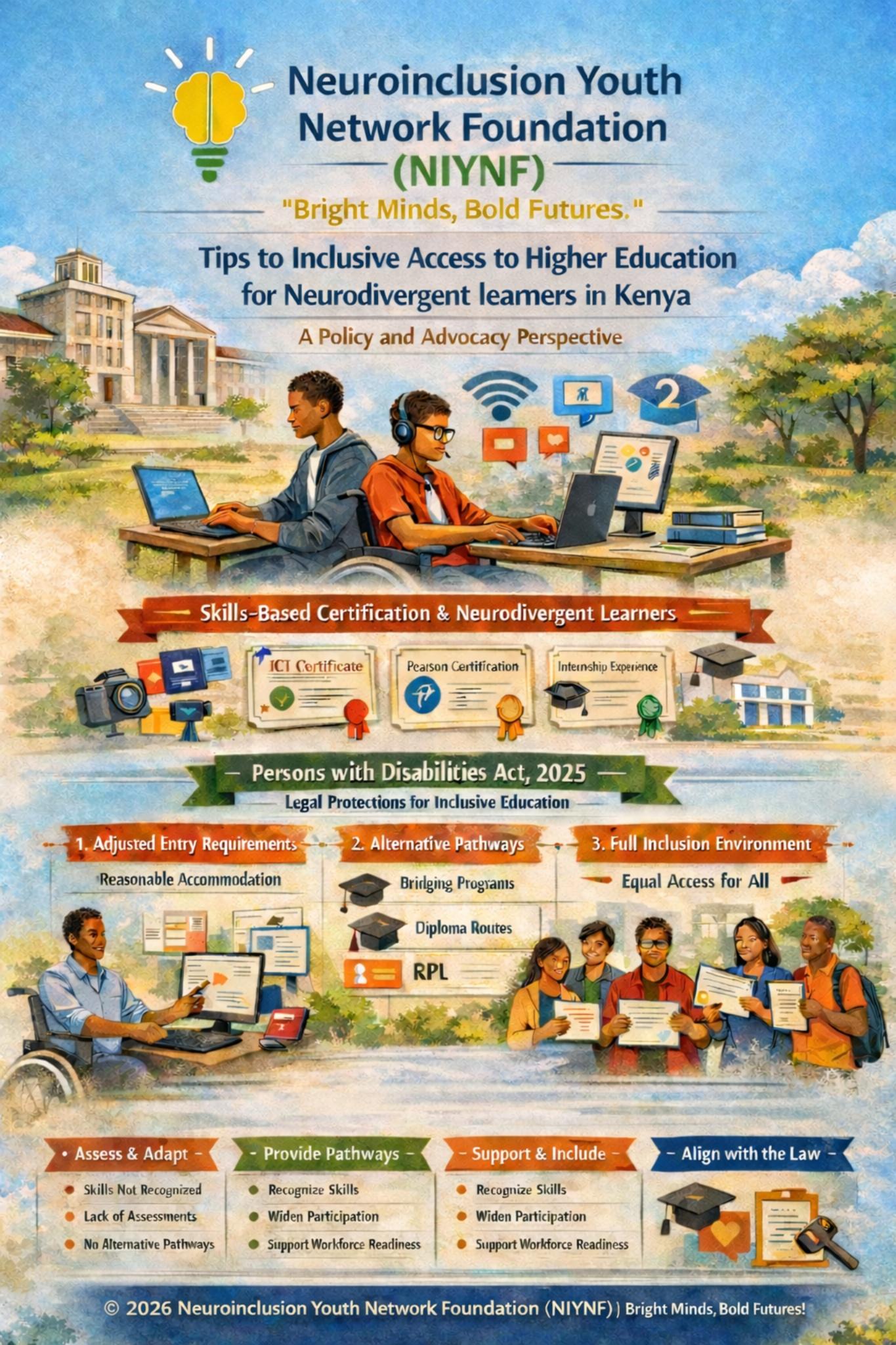
1. Adjust Entry Requirements Through Reasonable Accommodation
Traditional entry requirements often fail to recognize diverse learning profiles. Inclusive institutions should:
Consider alternative assessment methods beyond standard examination scores
Provide reasonable accommodation during admission processes
Recognize prior learning, skills, and certifications
Avoid one size fits all pass mark thresholds
The Persons with Disabilities Act, 2025 mandates learning institutions to take into account the needs of persons with disabilities when setting entry requirements and evaluation criteria.
2. Promote Alternative Pathways into Education
Not all learners follow linear academic pathways. Inclusive access can be strengthened through:
Bridging and foundation programmers
Diploma to degree transition routes
Recognition of Prior Learning (RPL)
Skills based and competency based certifications ( ICT and international certifications)
These pathways ensure neurodivergent learners are not excluded due to rigid academic structures at any educational level.
3. Create Fully Inclusive Learning Environments
True inclusion goes beyond admission. Institutions should provide environments that maximize academic and social development by offering:
Assistive technologies and adaptive learning tools
Flexible class schedules and assessment timelines
Accessible learning materials and formats
Individualized academic support services
The law emphasizes full inclusion within mainstream learning environments, not segregation.
4. Strengthen Individualized Support and Services
Neurodivergent learners benefit from personalized support systems, including:
Academic mentoring and coaching
Disability support offices with trained staff
Mental health and psychosocial support
Peer support and inclusion programmers
Individualized support is a legal and ethical requirement under the Persons with Disabilities Act, 2025, applicable to all levels of education.
5. Enforce Recruitment and Retention of Special Education Professionals
Inclusive education cannot succeed without qualified personnel. The Ministry responsible for education, in collaboration with institutions, must:
Recruit and retain special needs education professionals
Train teachers, lecturers, and administrators on neurodiversity inclusion
Build institutional capacity for inclusive teaching practices
This ensures sustainability and consistency in inclusive education delivery.
6. Align Institutional Policies With the Law
Educational institutions must actively align their internal policies with national legislation by:
Reviewing admission, assessment, and progression policies
Establishing clear disability inclusion frameworks
Monitoring compliance with the Persons with Disabilities Act, 2025
Legal alignment protects learners’ rights and strengthens institutional accountability.
Addressing Unlawful Medical Reassessment and Learners’ Rights
Recent public discourse has highlighted cases where learners with disabilities were improperly subjected to additional medical assessments by schools as a condition for admission or placement.
Under Kenyan law:
Schools have no mandate to require fresh medical assessments once recognized Educational and Medical Assessments have been completed by authorized government bodies.
Placement recommendations issued through official assessment processes are final and binding.
Any additional medical reassessment demanded by a school constitutes discrimination, a violation of learners’ rights, and a direct contravention of the Persons with Disabilities Act, 2025.
While some cases have since been resolved through the intervention of relevant authorities, these incidents reveal systemic gaps in school preparedness, placement procedures, and understanding of disability inclusion.
The issue is institutional and systemic, not personal. It underscores the urgent need for policy enforcement, institutional readiness, and coordinated support from the Ministry of Education and allied agencies.
Conclusion
Inclusive access to education for neurodivergent learners in Kenya is achievable through deliberate policy implementation, institutional commitment, and societal attitude change. The Persons with Disabilities Act, 2025 provides a strong legal foundation—what remains is action.
At the Neuroinclusion Youth Network Foundation (NIYNF), we continue to advocate for systems that recognize diverse minds, value skills alongside grades, and ensure that no learner is left behind.
Inclusive education is not charity. It is justice.
© 2026 Neuroinclusion Youth Network Foundation (NIYNF)
Bright Minds, Bold Futures